
Monthly Archives: July 2020

Holtec Faces Opposition – Updated

Questions About Competence, Quality Control & Legality

Holtec International on Thursday July 25, 2019 in Camden, N.J. Nj Tax Breaks (Photo: Tariq Zehawi and Thomas P. Costello/USA Today Network)

Who is Holtec?

Comentary by James Heddle

Holtec International, is a family-owned company, based in Camden, New Jersey, with mixed reviews from employees.  True to its name, the company has international ambitions for building small nuclear reactors (SMRs) and become dominant in the burgeoning global market of radioactive waste management.  It is working hard to convince the NRC and members of the public that concerns about its San Onofre ISFSI are over-blown and unfounded.

Holtec canisters are reportedly installed at three-dozen other reactor sites around the country, including Humboldt Bay in California.  Holtec is in the running, too, for a waste storage facility at the state’s Diablo Canyon nuclear site, scheduled for shutdown in 2025.

Holtec is also offering to buy four other US phased out nuclear power stations, – Oyster Creek in New Jersey, Pilgrim in Maine, Palisades in Michigan and Indian Point in New York.  As of this writing three of those proposed deals have yet to be approved, but on April 18, 2019, Holtec announced that it has closed the deal with Entergy to acquire the leaking and controversial Indian Point energy center just outside New York City after the last of its three reactors shuts down.

The pot of gold in the radioactive waste business is that, thanks to fees charged to ratepayers over the years, each plant has accumulated hundreds of billions of dollars in a decommissioning trust fund, which would all go to Holtec once the sales have been completed.

Profits to be Made from Nuclear Waste

Founded in 80’s by its India-born CEO Krishna ‘Kris’ Singh, Holtec is a family-owned company that has so far specialized in manufacturing reactor parts and radioactive waste storage systems.  But Mr. Singh’s vision and ambition for his company now extends to producing Small Modular Reactors (SMRs) and being a major player in the burgeoning nuclear plant decommissioning and radioactive waste management business.  

Holtec’s HI-STORM UMAX dry cask storage systems – the serious flaws of which are now the focus of dispute at California’s recently shuttered San Onofre radioactive waste storage site – where loading is currently halted – are reportedly already in use at over half of US reactor sites and many other places around the world. 

Holtec is also the would-be contractor for the proposed, highly contested Eddy-Lea waste dump in New Mexico, to which ‘just-get-it-out-of-here’ advocates are pushing to send San Onofre’s waste despite the strong opposition of citizen, government, business and Tribal groups there.

Holtec has recently partnered with the Canadian firm SNC-Lavalin, to form Decommissioning International (DCI) which is so far on-pace to buy six US nuclear plants scheduled for decommissioning – including Oyster Creek in New Jersey, Pilgrim in Maine, Palisades in Michigan and Indian Point in New York.  They will acquire the plants on a ‘possession only’ basis and sub-contract with CDI to complete their decommissioning process in as little as 8 years, well ahead of the 60 year timeline allowed by the NRC.

Their business model aims to quickly and cheaply demolish the plant structures and store the on-site waste in the flawed Holtec system, hoping to then get access to the billions of dollars now accumulated in trust funds at each site, built up over the decades from rate-payer charges.

CDI says it will be using Holtec’s NRC-approved “proto-prompt decommissioning” strategy to speed up the demolition of shuttered commercial power reactors and the ‘clean up’ and ‘restoration’ of their sites. 

It is worth emphasizing that this is no ordinary industrial waste we’re talking about here.  It involves man-made substances that are biologically lethal for millennia.  Mistakes in manufacturing or procedures, lapses in the rigorous established and evolving disciplines of prevailing ‘nuclear culture,’ can result in devastating contamination.  It requires operators of impeccable professionalism and integrity.

Trouble is, in a hazardous business that demands such high qualifications, both SNC-Lavalin and Holtec have histories of bribery scandals and shady political dealings.

[ As this article goes to post, Yahoo Finance has announced that CDI “has been awarded its first commercial contract, worth hundreds of millions of dollars.” ]

Bribery at the TVA

Back in 2010 Kris Singh and Holtec were involved in an alleged bribery scandal at the Tennessee Valley Authority (TVA).  As a result of a criminal investigation, the TVA created a formal suspension and debarment process and, in an unprecedented move, debarred Holtec from doing business with it for 60 days.  Holtec was also reportedly forced to agree to pay a $2 million ‘administrative fee’ and to submit to independent monitoring of its operations for twelve months. 

For its part, SNCL has, since 2012, been embroiled in a series of other similar scandals, which are currently rocking the Canadian government to the point where they recently even sparked calls for the resignation of Prime Minister Justin Trudeau.

That’s the company whose shadow looms over San Onofre, New Mexico and all the reactor sites around the country where its questionable canisters are storing tons of radioactive waste.

Here are some recent developments:

Late afternoon light shines on the proposed nuclear waste dump site of Yucca Mountain February 7, 2002 at Nellis Air Force Base located approximately 90 miles north of Las Vegas, NV. In January, the U.S. Department of Energy endorsed a plan to transport vast amounts of radioactive waste from nuclear power plants across the nation for burial under Yucca Mountain, where it will take 10,000 years to decay. U.S. President George W. Bush could annouce his support for the plan, which is opposed by many in Nevada, as early as this week. (Photo by David McNew/Getty Images)

Pandemic Allows for New Front in Fight Against Southwest Nuclear Waste Storage Contracts

Activists, industry, lawmakers push for delays to interim spent fuel storage facilities planned in Texas, New Mexico

July 10, 2020 at 2:26 pm ET

Two proposals to send high-level spent nuclear fuel to sites in Texas and New Mexico are seeing renewed opposition as environmental activists, the oil and gas industry and lawmakers on both sides of the aisle have formed an unlikely and informal alliance leveraging the pandemic as a reason to delay. 

The proposed Texas and New Mexico facilities — which are licensed by Interim Storage Partners LLC (a joint venture of Orano USA and Waste Control Specialists) and Holtec International, respectively — have applications under review by the Nuclear Regulatory Commission for consolidated interim storage facilities intended to serve as temporary repositories for high-level nuclear waste from all over the country. 

The ISP facility already stores low-level waste, but the proposals would expand its license to store high-level waste, which is exponentially more radioactive, for at least 40 years. The Holtec facility would be built on undeveloped land; both facilities are located in the Permian Basin, home to more than 7,000 oil and gas fields.

While most of the country’s more than 90,000 metric tons of nuclear waste is stored where it is generated, the Nuclear Waste Policy Act amendments of 1987 mandated that the country use Nevada’s Yucca Mountain as its only permanent nuclear waste repository. But since the Obama administration scrapped those plans for Yucca in 2009, the United States has not had a long-term destination for the radioactive waste produced by its nuclear energy facilities.

Unlikely agreement

Now, the proposals for these two interim alternatives are eliciting pushback of their own, especially in light of the coronavirus. The pandemic has brought renewed vigor to the fight by both environmental activists and the oil and gas industry, all of whom are concerned about the inability of local stakeholders to sufficiently review and weigh in on the current proposals and statements. 

“Just look at what’s happened in Texas today: COVID numbers are just going through the roof,” said Tommy Taylor, director of oil and gas development for the family-owned Fasken Oil and Ranch Ltd. in Midland, Texas. “It’s just hard enough to keep your businesses afloat; we need a lot more time to be able to respond effectively and say what we need to say….

Read more


State of New Mexico says nuclear waste project poses disproportionate risk, locals supportive

Adrian Hedden, Carlsbad Current-Argus

New Mexico’s Executive Branch and activist groups continued their fight against a nuclear waste repository proposed to be built near the Eddy-Lea county line while supporters touted promises of economic benefits to the region and southeast New Mexico’s role in addressing the nation’s nuclear waste.

The debate came during a Tuesday virtual public hearing hosted by the federal Nuclear Regulatory Commission (NRC) to seek public comments on an environmental impact statement (EIS) issued by the NRC for Holtec International’s application for a license to build a consolidated interim storage facility (CISF) that would temporarily hold spent nuclear fuel at the surface while a permanent underground repository is developed.

The draft EIS issued in March found the project would have “minimal” impact on the environment if it was allowed to be built and operated. Read more…


PublicWatchdogs.org

Nine State Attorneys General file legal documents with NRC protesting Holtec as a nuclear waste vendor.

In an unprecedented act of unity, nine attorneys general from nine separate states have intervened in a case involving nuclear safety and Holtec International. Read more


Holtec under ‘criminal investigation,’ EDA says in since-redacted court filing

Holtec International, which received one of the biggest tax credits in New Jersey history, is under criminal investigation, according to a legal brief filed Monday by the New Jersey Economic Development Authority.

The brief was in response to a lawsuit Holtec — an energy technology company — filed against the EDA in March for holding up a $26 million payment on its $260 million tax incentive to build a facility in Camden. The delay was because of an allegedly false answer Holtec gave on its 2014 tax credit application.

“Holtec’s misrepresentations — which include its failure to disclose a prior government debarment by the Tennessee Valley Authority (the ‘TVA’) for bribing an official of that agency — first came to light during an investigation conducted by the Governor’s Task Force on the Economic Development Authority’s Tax Incentive Program, and they are now the subject of an ongoing criminal investigation,” reads the June 22 brief by attorney Ricardo Solano. Read more


DON’T WASTE MI, et al. FILES FEDERAL LAWSUIT CHALLENGING NATIONAL HIGH-LEVEL RADIOACTIVE WASTE DUMP TARGETING NEW MEXICO  

Petitioners charge Nuclear Regulatory Commission inadequately disclosed irradiated nuclear fuel transport routes through 45 states

WASHINGTON, D.C., JUNE 24, 2020  — Today the national grassroots environmental coalition Don’t Waste Michigan (DWM), et al. filed an appeal with the U.S. Court of Appeals for the District of Columbia Circuit (Case No. 20-1225), requesting review of an April 23, 2020 Order by the U.S. Nuclear Regulatory Commission (NRC). NRC’s Order rejected DWM, et al.’s challenges to Holtec International/Eddy Lea Energy Alliance’s application to build a massive “consolidated interim storage facility” (CISF) for nuclear waste in southeastern New Mexico. Holtec proposes to store as much as 173,000 metric tons of highly radioactive irradiated nuclear fuel – more than twice the amount currently stored at U.S. nuclear power reactors – in shallow pits on the site. 

DWM, et al. is comprised of the following seven organizations, from six states across the country: Citizens for Alternatives to Chemical Contamination, MI; Citizens’ Environmental Coalition, NY; Don’t Waste Michigan; Nuclear Energy Information Service, IL; Nuclear Issues Study Group, NM; Public Citizen (DC, TX); San Luis Obispo Mothers for Peace, CA. Toledo, OH-based attorney Terry Lodge serves as the coalition’s legal counsel. Read more

Victory! For the Great Lakes

Map – Detroit Free Press

Canadian utility formally drops underground radioactive waste storage next to Lake Huron

, Detroit Free Press

An Ontario nuclear power generating company has officially dropped its pursuit of a deep underground storage facility for low- to intermediate-level radioactive waste within a half-mile of Lake Huron.

Ontario Power Generation has withdrawn an application for a construction license filed with the Canadian Nuclear Safety Commission to build a Deep Geologic Repository in Kincardine, Ontario. The utility also withdrew from an environmental assessment of the project by Environment and Climate Change Canada, the nation’s environmental regulator.

With that, OPG’s more than 16-year pursuit of a deep underground repository to store almost a half-mile underground some radioactive waste from its 20 nuclear reactors comes to an end — at least at the controversial location by Lake Huron.

Despite OPG’s repeated assurances that the repository would be a completely safe, long-term waste storage solution, opposition to the project was nearly unanimous in Michigan. Read more…

PG&E Wants CCAs to Go Nuclear


PG&E pushing free Diablo Canyon nuclear energy

by James Heddle – EON

Meanwhile, up the California coast at the state’s last operating nuclear plant Diablo Canyon, the facility’s bankrupt, convicted felon and admitted mass murdering utility Pacific Gas & Electric (PG&E) has come up with a new scam.  In an opaque and convoluted ‘procurement bundling proposal’ to the California Public Utilities Commission (CPUC) the utility is offering nuclear-generated energy to CCA’s at bargain rates. 

The towering irony here is that the motivation for the legislation mandating local and regional proliferation of Community Choice Aggregation entities – CCAs – was to facilitate the transition to clean, green, renewable energy sources.

PG&E fought CCAs tooth and nail. It spent $46.1 million in 2010 to sponsor an initiative, Prop. 16 , that would have outlawed CCAs and enshrined nuclear energy in the state constitution.  Prop. 16 was roundly defeated at the polls.

According to BallotPedia, “If Proposition 16 had been approved by voters, it would have henceforward taken a two-thirds vote of the electorate before a public agency could enter the retail power business. This would have made it more difficult than it is currently for local entities to form either municipal utilities, or community wide clean electricity districts called Community Choice Aggregators (CCAs). Forming a local municipal utility or a CCA, if Proposition 16 had been approved, would have required the approval, through election, of 2/3rds of the voters who live in the area of the would-be local municipal utility or CCA.”

Undaunted by that resounding failure, PG&E is now trying to co-opt the growing CCA movement.

Jill ZamEk, of the MothersForPeace explains it this way:
“A pressure campaign by PG&E and the CPUC, Community Choice programs across the state have been asked to buy nuclear power from Diablo Canyon. Very few have.

“However, our local program, Monterey Bay Community Power, (soon to be renamed Central Coast Community Energy!) has preliminarily agreed to accept nuclear as 20% of their power portfolio. While classified as carbon free, nuclear power is certainly not renewable, and potentially a very bad move for public relations.

“We believe that community choice programs should stick to cheaper, cleaner sources of power like wind and solar and avoid helping PG&E fund it’s expensive and expiring nuclear plant, already set to end operations in 2025.”

Long-time nuclear safety advocate Don Eichleberger warned in a letter to CCAs,

PG&E is making a effort to unload the excess power being produced at their Diablo Canyon Reactor on to Community Choice Aggregators across the state for free so they can continue operation of their unneeded nuke. Clean Power SF, our local aggregator is considering the proposal now. Below is a letter I sent to them urging that they refuse the free money being offered.  If you live in San Francisco I hope you will notify them and voice your opposition to the offer. Even if you don’t live in the city, it might help for them to hear from you. Sonoma and Alameda have already refused the offer; I understand Santa Cruz and Monterrey have accepted it.
Definitely keep a wary eye out for this offer being made if your community has a CCA in the PG&E service area.

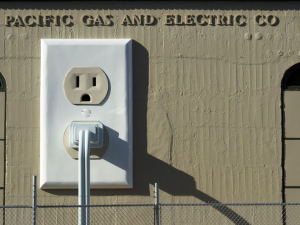
An art installation titled “Outlet-plug-cord” (2015) by Basal Ganglia Studio is displayed on the side of a Pacific Gas & Electric substation in Petaluma.
(John G. Mabanglo / REX Shutterstock)


Meet the new PG&E. It looks a lot like the old PG&E

Sammy Ross – L.A. Times
Pacific Gas & Electric Chief Executive Bill Johnson promised his company would emerge from bankruptcy a “reimagined utility.”

But as PG&E prepares for life after Chapter 11 — a Bankruptcy Court judge filed a written decision Wednesday saying he would approve the company’s reorganization plan — it’s unclear there’s anything fundamentally different about the utility, which over the last decade has caused a deadly pipeline explosion, deadly fires and days-long power shut-offs affecting millions of people. Read more

Doomsday Clock Ticks Closer

Scientists move the Doomsday Clock 100 seconds to midnight

Screenshot of the 2020 Doomsday Clock Announcement from the Bulletin of Atomic Scientists YouTube Channel.

The Final 100 Seconds

– CounterPunch.org

Never before this year 2020 has the world-famous Doomsday Clock registered only “100 seconds-to-midnight.” According to the Science & Security Board, Bulletin of the Atomic Scientists, since WWII, the world has never been so perilous.

Alas, it’s been a long journey (73 yrs) all the way up to 100 seconds to midnight versus the original 1947 setting of seven minutes to midnight. The safest setting was at 17 minutes to midnight in 1991 at the end of the Cold War. The wonderfully famous iconic clock is located in the lobby of the Bulletin offices at the University of Chicago.

Unceremoniously, recklessly the Trump administration carries the indisputable title as one of the most dangerous executives in the history of the country with two key issues that determine the clock’s settings: (1) climate change deniers and (2) atomic bomb explosion enthusiasts for simplicity of political gain, nothing else.

The Doomsday Clock is set by a board of scientists and professionals with depth of knowledge about nuclear technology and climate science. They are established professionals that often provide expert advice to governments and international agencies. Impressively, the Bulletins’ Board of Sponsors includes 13 Nobel Laureates. Read more…

WASHINGTON, D.C. – January 23, 2020 – The iconic Doomsday Clock symbolizing the gravest perils facing humankind is now closer to midnight than at any point since its creation in 1947. To underscore the need for action, the time on the Doomsday Clock is now being expressed in seconds, rather than minutes: Today, the Bulletin of the Atomic Scientists’ Science and Security Board in consultation with the Bulletin’s Board of Sponsors, which includes 13 Nobel Laureates, moved the Doomsday Clock from two minutes to midnight to 100 seconds to midnight.

As the statement issued today by the Bulletin of the Atomic Scientists explains: “Humanity continues to face two simultaneous existential dangers—nuclear war and climate change—that are compounded by a threat multiplier, cyber-enabled information warfare, that undercuts society’s ability to respond. The international security situation is dire…Read more

Anonymous Sources

Afghan Bounty Scandal Comes at Suspiciously Important Time for US Military Industrial Complex

By Alan Macloed – Mint Press
The latest scandal, like others before it, is based on scant testimony by anonymous officials and has had the effect of pushing liberal opinion on US foreign policy into a far more hawkish direction. Read More

Why it keeps Hapening – Bolton is Right

Why US Empire Works So Hard to Control the International Narrative About Russia

CaitlinJohnstone.com / Consortium News

“I think as Justice Jackson said in a famous decision, the Constitution is not a suicide pact,” Bolton said. “And I think defending the United States from foreign threats does require actions that in a normal business environment in the United States we would find unprofessional. I don’t make any apology for it.”

I am going to type a sequence of words that I have never typed before, and don’t expect to ever type again:

John Bolton is right.

Read more

Radioactive Waste in Landfills? Weakened Safety Rules? What Could Possibly Go Wrong?


NIRS – Urgent Action Needed!
(Very Low Level Radioactive Waste is not good for us)

Tell the NRC & Congress: No nuclear waste in our landfills

Radioactive symbolThe Nuclear Regulatory Commission (NRC) is planning a very dangerous change to the way radioactive waste is handled. Some man-made nuclear waste, mainly from nuclear power, is very long-lasting and dangerous to human health and the environment.  Disregarding this danger, the NRC proposes to let regular landfill operators dispose of this radioactive waste by authorizing them as “specific exempt.” This would almost certainly result in nuclear waste leaks into our water, air, crops, and communities. Tell the NRC and your members of Congress: Don’t dump radioactive waste into our landfills or any other places that are “exempt” from nuclear controls.  Make comments here


Weakened Safety Regulations?

This from The NIRS Team –
Diane D’Arrigo
Luis Hestres
Denise Jakobsberg
Tim Judson:

The Nuclear Regulatory Commission’s (NRC) duty is to protect the health and safety of the American people from an inherently dangerous industry. But for decades, the NRC has been badly falling down on the job.

The NRC now wants to ax one of its most basic safety regulations: emergency plans for nuclear disasters. The NRC wants to rewrite the rules so that certain kinds of new reactors will be exempt from providing site-specific Emergency Response Plans that must be approved by the Federal Emergency Management Agency. Instead, the proposal would let plant owners determine what the size of the Emergency Planning Zone (EPZ) should be—or whether offsite emergency planning is necessary at all.

This proposal would leave the public unprotected in the case of a large release of radiation. The NRC would let newfangled reactors that are untested and unproven off the hook and allow plant owners to police themselves when it comes to safety. When disaster strikes, public officials and plant operators would have to figure out—on the fly—how to protect people, who and when to evacuate, how to notify people, how to transport and shelter them, and more.

The comment period for this terrible idea closes in three weeks. Tell the NRC: Don’t play with our emergency plans