
“Boo, Yes.” – Coastal Commission Vote Sets San Onofre Radioactive Dump-by-the-Sea in Concrete – Updated

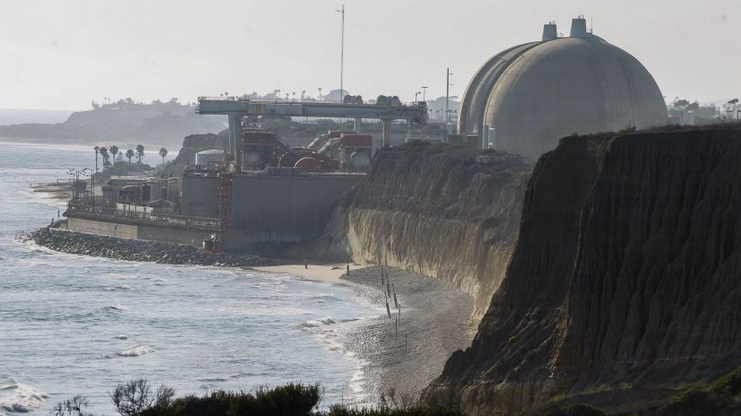
Southern California Edison’s radioactive waste dump-by-the-sea (center left) sits between the rising sea and the state’s main north-south rail and highway corridor in an earthquake and tsunami zone, surrounded by a population of 8 million people. What could possibly go wrong? – Photo from EON’s forth-coming feature-length documentary SHUTDOWN – ShutdownFilm.com


By Mary Beth Brangan and James Heddle – EON

“We’ll hold our noses and vote.”
Despite passionate public comments from community groups and individuals – and even concerned comments from some Commissioners themselves – presenting a long list of the legitimate public safety and environmental risks posed by the San Onfre dry storage facility for 3.6 tons of intensely radioactive fuel rods being created by Southern California Edison, the California Coastal Commission voted unanimously on July 16, 2020 to give the project the go-ahead.  There were, however, two “yes, boo” votes.

[ As of July 24, 2020, Attorney Mike Aguirre writes: “If people want to challenge the Coastal Commission decision on the grounds that (1) the hearing was unfair it should have been an evidentiary hearing and it was marred be cause the commission had already made up its mind before the hearing started; (2) the findings don’t support the decision and  (3) the evidence does not support the finding we must act within 30 days from the decision or sooner.” ]

Community Pleas for a Hot Cell Facility
In a remarkable show of community agreement, the bulk of the public comments from individuals and organizations advocated for the preservation of existing cooling pools plus the construction of a sealed ‘hot’ or ‘dry cell’ building.  This would allow damaged canisters or those containing damaged fuel to be robotically repaired or repackaged into sturdier thick casks that can be monitored and repaired as needed and meet transportation safety requirements. 

All current thin welded-shut Holtec canisters at San Onofre are gouged along their entire 18 ft. length as they are lowered into the vaults, initiating stress corrosion and galvanic corrosion that’s increased in the salty ocean climate.  The chance is high that these damaged canisters will need to be repackaged.  Also called for was the creation of a building where the casks would be protected from the elements and terrorists.  Many cited the model of the Swiss Zwilag facility that includes all these common sense precautions. 

Southern California Edison Plan
None of these provisions are included in the Southern California Edison plan for decommissioning, which calls for:

  • Transferring the remaining highly radioactive fuel assemblies out of the cooling pool and into thin stainless steal canisters to be lowered into concrete silos in an Independent spent fuel storage installation (ISFSI) just above a popular surfing beach;
  • Demolishing the pools;
  • Rubblization of the remaining radioactive reactor domes and other structures to be shipped for ‘disposal’ – possibly in ordinary landfill sites as currently proposed by the NRC – in California or other states;
  • Returning the site to so-called ‘Green Field’ status to be used for public recreation or,
  • Reusing the cleared site to relocate the dry cask ISFSI to higher ground further from the rising surf, if no off-site alternative has been found.

Citizen Concerns
Citizen opponents to the plan question the durability and safety of the thin Holtec stainless steel canisters being used by Edison to store the radioactive fuel rods. They point out that these types of canisters are known to be susceptible to through-wall cracking caused by the stress of the corrosive salt sea air. They warn that through-wall cracks can occur in as little as 17 years even without being gouged first, as is the case at San Onofre.
Remember, each of these 72 canisters contains more radioactivity than was released from the Chernobyl disaster. [ A 73rd canister contains greater than Class C waste. ]

The California Coastal Commission requires that the canisters be preserved well enough to
be able to be moved by the year 2035.  However, there is no proven way to check the condition of the fuel inside the welded canisters without opening them and inspecting the enclosed fuel rods.  This would only be possible with a hot cell facility that allows robots in an inert gas filled environment to handle the intense radioactivity safely without exposure to oxygen or people. 

The Holtec Hi-Storm Umax dry storage system for spent fuel at San Onofre Nuclear Generating Station. (Courtesy Southern California Edison)

Too Hot to Move Until the Year 2100
Additionally, the Nuclear Waste Technical Review Board’s 2019 report, Preparing for Nuclear Waste Transport  clearly states that huge canisters like those at San Onofre that contain 37 fuel assemblies each of extra thermally hot and more radioactive high burnup fuel must be repackaged into smaller casks.  If not repackaged, the extra heat and radioactivity will prevent them from being transported until the year 2100.  This is the case even though the designs of the canisters have been licensed by the NRC. (pg. 76)

So even if by some miracle, the 5/8 inch thin canisters that are already gouged significantly survive to the year 2035, they will be too hot to transport.  However, predictions are that within only 20 years sea level rise and increased storm surge from climate change will affect the San Onofre dumpsite 108 ft from the shore.  Again, repackaging is only possible in a hot cell facility and that was blocked by Southern California Edison and the NRC representative who said it wouldn’t be needed.

From the Nuclear Waste Technical Review Board’s 2019 report pg. 77:  “DOE has examined the trend in SNF dry storage at nuclear power plant sites (Williams 2013). On average, during 2004–2013, the nuclear utilities discharged SNF that has higher burnups (approximately 45 GWd/MTU) than previously discharged SNF and, therefore, is thermally hotter and more radioactive. In addition, the nuclear utilities are loading SNF into larger dry-storage casks and canisters to improve operational efficiency and reduce cost. The largest of these canisters now holds as many as 37 PWR assemblies or 89 BWR assemblies. As a result, these larger casks and canisters are hotter than earlier dry-storage casks and canisters; therefore, they will take longer to cool sufficiently to meet transportation requirements.DOE estimated that if SNF was repackaged from large casks and canisters into smaller standardized canisters (and using standard assumptions about the operating lifetime of the U.S. fleet of nuclear reactors), DOE could remove SNF from all nuclear power plant sites by approximately 2070. However, if no repackaging occurs, some of the largest SNF canisters storing the hottest SNF would not be cool enough to meet the transportation requirements until approximately 2100 (Williams 2013).

Flooding Dangers
The location of the waste storage facility yards from the surf, inches above the water table  in an earthquake and tsunami zone is given added significance by a report by Public Watch Dogs.  Consulting expert Paul Blanch revealed that Edison’s own data show that  the current site and its immediate surroundings are vulnerable to severe flooding damage in the event of an earthquake and tsunami.  Blanch’s report suggests that, in such an event, all 74 of the site’s waste storage silos could be catastrophically damaged.

Edison’s own assessment of tsunami and flooding risks at its ISFSI-by-the-Sea, Graphic courtesy SCE via PublicWatchdogs


Here are video clips from the meeting excerpted as a public service by EON, the Ecological Options Network – EON3.org and links to recent news coverage.

[The full meeting video is here.]

Video Excerpts

SanOnofreSafety.org

Public Comments by San Onofre Safety founder Donna Gilmore

SanClementeGreen.org

Public Comments by San Clemente Green co-founder Gary Headrick, U.S. Representative Mike Levin (D-CA), Adm. Len Hering.

PublicWatchdogs.org

Public Comments by Public Watchdogs spokespeople Charles Langley, Paul Blanch, Nina Babiarz.

SanDiegoSierraClub.org

Public Comments by San Diego Sierra Club spokesperson Cody Petterson.

Coalition for Nuclear Safety
Public Comments by Coalition for Nuclear Safety spokespeople Dave Rice, Bart Ziegler, Cathy Iwane.

Alice McNally – Coalition for Nuclear Safety
Public comments by Alice McNally of the Coalition for Nuclear Safety  

Michael Aguirre – Aguirre & Stevenson
Comments by Michael Aguirre of Aguirre & Severson LLP.

Surfrider Foundation – Surfrider.org

Public Comments by Surfrider Foundation spokeswomen Rose Acheson. Katie Day, Mandy Sackett

Commissioner Wilson Questions CCC Staff & SCE

Commissioner Mike Wilson questions Coastal Commission staff members Alison Dettmer and John Webber and Edison spokesperson Tom Palmisano.


Commission Comments and Final Vote

Commissioners Dayna Bochco, Roberto Uranga, Sara Amenzader and Chair Stephen Padilla comment and vote in the July 16, 2020 California Coastal Commission meeting on radioactive waste storage at the shuttered San Onofre nuclear plant.


News Links

Orange County Register

By Teri Sforza

Inspection plan for San Onofre’s nuclear waste gets green light from Coastal Commission
‘It’s never easy to really approve of this kind of a situation,’ one commissioner said, ‘but it’s the only recourse at the moment’

About a dozen of the 73 nuclear waste canisters at San Onofre are slated for robotic inspection over the next 15 years, to the dismay of some critics who lobbied for more, according to the maintenance plan for its dry storage system approved by the California Coastal Commission.

“I have a little bit of a gnawing feeling,” Commissioner Mark Gold said at the end of the 4 1/2-hour online meeting Thursday, July 16. “I know this is based on extensive data and what has occurred in the industry, but, when you look at 1 in 10, it’s hard to guarantee that’s representative of the whole.”

Two commissioners actually prefaced their “yes” votes with a “boo.”

“From the perspective of the commission and Southern California Edison, we all need to advocate for getting this (waste storage system) in a different location than it currently is,” said booer Mike Wilson.

Read more


Times of San Diego

Coastal Panel Votes 10-0 to Allow Storage of Spent Nuclear Fuel at San Onofre
Posted by Chris Jennewein

The California Coastal Commission voted 10-0 in a special meeting Thursday to approve an inspection and maintenance program allowing Southern California Edison to store spent nuclear fuel in a storage site at the decommissioned San Onofre Nuclear Generating Station.

The program outlines actions SCE will take to inspect the canisters that contain spent nuclear fuel, as well as how potential issues with the canisters will be remedied. Read more


Donna Gilmore of SanOnofreSafety.org comments on the above article:

The Commission staff report was severely flawed. The Coastal Commissioners asked great questions, but were given lies or misleading answers from SCE, LPI, NRC, and Coastal Commission management. New leadership is needed at the Coastal Commission and the NRC. They are not protecting the public or the environment.

All these parties know or have evidence these thin-wall canisters cannot be inspected for cracks nor adequately repaired. They know cracks are likely already growing through these thin-wall canisters that are only 5/8″ thick. Some canisters are already 17 years old.

SCE has no real plan to prevent or stop cracks, leaks or hydrogen gas explosions in these canisters. Instead of a plan, they hope nothing goes wrong until they can dump this mess onto some other community or at least turn over title to the federal government (at the existing site).

With each canister holding roughly a Chernobyl nuclear disaster full of radionuclides (as admitted to by SCE), none of us will be safe until these thin-wall canisters are replaced with thick-wall casks (10″ to 19.75″ thick), the standard in most of the world.

The coronavirus pandemic continues to reveal just how disfunctional our country is compared to our European and other friends around the world. It’s time to learn lessons from them. This includes nuclear storage lessons.

I urge everyone to look at the Swiss Solution for storing highly radioactive nuclear fuel waste.

https://sanonofresafety.org/swiss/

If we don’t learn these lesson now, the resulting “nuclear pandemic” will make the coronavirus pandemic look like the good old days.

A recent Sandia National Lab report for the Dept. of Energy (Dec 2019 Technology Gap Report) states risks of short-term through wall cracks in these thin-wall canisters is a priority #1 problem that needs solving. They also said a dry fuel handling system [e.g., hot cell facility] is needed for replacing canisters. And they also said they need to study what the consequences will be from through-wall cracks. Why did the Coastal Commission managers not tell the Coastal Commissioners this? Why did they defer to the LPI consultants (who were paid by SCE)?

Why when one of the Coastal Commissioners asked LPI (after looking at the safety checklist comparing thin canisters to thick casks) if there were better systems than what SCE is using, LPI responded “it’s political”?

https://sanonofresafety.files.wordpress.com/2018/05/10reasonstousethicknuclearwastestoragecasks.jpg?w=1024


PublicWatchDogs.org Press Release – “Fear and loathing…”

California Coastal Commission sings sad “SONGS” about Southern California Edison’s Inspection and Maintenance Program (IMP) for nuclear waste

Unanimous vote gets “boos” from two Commissioners!
In a vote tinged with boos, and what one Commissioner described as “fear and loathing” the California Coastal Commission voted “yes” today to a Southern California Edison plan for the beachfront nuclear waste dump at San Onofre State Beach Park. the site of the failed San Onofre Nuclear Generating Station (SONGS). Read more


New York Times

A Big California Quake Just Got ‘a Little Likelier’
A new analysis puts the likelihood of an earthquake slightly higher than earlier forecasts, but researchers said there’s no reason to panic.

By Henry Fountain

An analysis of recent changes along earthquake faults in Southern California suggests there is an increased possibility of a major quake on the San Andreas Fault, researchers said Monday.

The changes in fault stresses, resulting from a pair of strong earthquakes last July, increase the likelihood of a quake on a stretch of the San Andreas in the next 12 months to about 1 percent, or three to five times the probability of earlier forecasts, the researchers said.

A major quake on that section of the fault, called the Mojave, could devastate Los Angeles and its surrounding communities, which are home to 18 million people.

“We are still saying this is unlikely,” said one of the researchers, Ross S. Stein, a former United States Geological Survey geophysicist who now runs a consulting company. “It’s just a little likelier.”

The findings were published in the Bulletin of the Seismological Society of America.

Read more

A 770-ton nuclear reactor pressure vessel from the old Unit 1 facility at the San Onofre Nuclear Generating Station has completed its journey through three states to a disposal site in Clive, Utah. (Nevada Department of Transportation)


Los Angeles Times

770-ton load from San Onofre nuclear plant arrives at Utah disposal site

By Rob Nikolewski

The seven-week journey of an old but vital piece of the San Onofre nuclear power plant, a shipment weighing in at 770 tons, has been completed.

The reactor pressure vessel that helped generate electricity at Unit 1 of the plant arrived last week at a licensed disposal site about 75 miles west of Salt Lake City after being shipped by rail and then over highways in Nevada and Utah.

The removal of the vessel “is an important milestone” in the larger efforts to decommission the San Onofre Nuclear Generating Station, or SONGS, said Doug Bauder, vice president at Southern California Edison and chief nuclear officer at the facility.

Read more

San Onofre News – 7-1-2020 – Updated

Edison’s own assessment of tsunami and flooding risks at its ISFSI-by-the-Sea, Graphic courtesy SCE via PublicWatchdogs

Headlines
– Citizens demand electeds intervene in SONGS decommissioning
-Potentially catastrophic tsunami risks to the San Onofre radioactive waste dump revealed
-Huge radioactive San Onofre pressure vessel takes a train to Utah
– Radioactive transport risks
– Critics respond to Senator Levin’s Task Force Report on radioactive waste storage at SONGS
– What’s the future of SONGS?


A ‘hot cell’ or ‘dry cell’ is a sealed building filled with helium in which damaged radioactive containers and materials can be handled remotely by robotics for inspection, repair and repackaging.

‘Hot Cell’ Demanded

Photo: MIT

Citizens tell CCC “Cancel the Songs Waste Storage Permit!”
A Petition launched by the Samual Lawrence Foundation calls for the California Coastal Commission to amend its permit to decommission San Onofre Nuclear Generating Station.

A sample letter from Cathy Iwane reads in part:

Removing the spent fuel pools at San Onofre without a validated handling facility on-site is an irresponsible decision. The spent fuel pools are the last option for dealing with a damaged canister.

The Coastal Commission staff report lacked measures to ensure the protection of our coast and cities along the California coast from long-term environmental contamination.

…[C]riteria for granting a permit:
Require a plan for damaged nuclear waste storage canisters not fit for transportation
Require applicant to construct a handling facility on-site to mitigate damaged canisters
Retain spent fuel pools, until a validated handling facility is built (i.e. hot cell)
Damaged canisters could expose the land, air, and water to dangerous radiation which would harm California’s natural resources, coastal tourism, economy, and residents.
Coastal storage and decommissioning permits must require a condition that the applicant maintain the cooling pools and subsequently construct a hot cell on-site at the site.
This battle cry is heard at 65 similar storage sites around the US. Please respond by action, as if your office depends on it!

Info and sign-on letter:

Flood of Evidence Reveals ‘Severe’ Tsunami Risks at Edison’s San Onofre Waste Dump-by-the-Sea
PublicWatchDogs.org

On June 24, 2020, Public Watchdogs made a formal PowerPoint presentation to the Nuclear Regulatory Commission in support of their petition to revoke Southern California Edison’s right to bury nuclear waste at the site of the failed San Onofre Nuclear Generating Station (SONGS). Their presentations to the NRC documented the potential results of a tsunami flood.  Edison’s own evidence shows the ISFSI is in the ‘severe damage’ zone.

For PDF’s and a video go here.

Petition snip:
“From Edison’s own submittal under oath, executed on August 26, 2013 under penalty of perjury, the area of the ISFSI may be submerged by an unspecified level of seawater during a tropical storm or tsunami resulting in potential rupture of all 72 spent fuel storage casks. This event is likely to result in rupture of multiple casks and the release of millions of curies of long-lived radioactive isotopes.The impact of the thermal shock of cold water from the Pacific Ocean immersing the 452-degree Fahrenheitmultipurpose canister (MPC)is unanalyzed and void of regulatory scrutiny. It is possible that this thermal shock could challenge the only boundary between millions of curies, the environment, and millions of people. In addition, potential criticalityas discussed in 10 CFR 72.124 has not been addressed.” [emphasis added


A huge convoy carrying a low-level nuclear reactor is making its way through Nevada. Last week it passed through the Coyote Springs Valley via U.S. Highway 93. PHOTO BY CHARLENE PAUL/The Progress.

The hazards to roads, bridges, culverts, rails and people along the journey of this radioactive San Onofre reactor vessel will be repeated 99 times if the nuclear industry gets its way.  99 more reactors need to be decommissioned.  99 more reactor vessels will be moved to dump sites.  Industry plans to also move the high level intensely radioactive waste around the country to “interim sites” and theoretically, move them again to a permanent site.  This is insanely risky.

Spent Nuclear Reactor Passes On Its Way To Disposal
July 8, 2020

By CHARLENE PAUL – The Progress

A nuclear reactor vessel from southern California’s decommissioned San Onofre Nuclear Generating Station slowly made it’s way through the Coyote Springs Valley on Monday, June 29.

At about 5:30 am the convoy left the Apex Industrial Park in North Las Vegas. The 770-ton load on a 122-foot-long trailer powered by six heavy-duty Class 8 trucks began its one-way, 400-mile trip to a disposal site in the desert in Clive, Utah. Read more


Decommissioned nuclear reactor to hit Nevada roads

By Mick Akers

The largest object to travel on Nevada roads will set out on its over week-long journey next week.

The 1.5 million-pound, 16.5-foot-diameter decommissioned reactor pressure vessel from Southern California Edison’s San Onofre Nuclear Generating Station will hit the road early Monday morning from Apex in North Las Vegas, the Nevada Department of Transportation announced Friday.

To keep the load off Interstates 15 and 80, the vessel will mainly travel on U.S. Highway 93 and State Route 318 before crossing the Utah border on its way to Clive. Read more – Included video

Screen grab from RJ video

SONGS’ radioactive 770-ton pressure vessel takes a train to Utah

Debris from demolished nuke plants is coming to Utah, where EnergySolutions is proposing a new landfill

By Brian Maffly   Salt Lake Tribune

Across the country, aging nuclear power plants are getting retired and coming down, generating a new and potentially vast waste stream that could head to Utah.

Some remains of California’s San Onofre Nuclear Generating Station, including its 770-ton pressure vessel, already are on train cars crossing Nevada to the nation’s largest repository for low-level, or Class A, waste in Utah’s remote West Desert. Read more…

Beyond Nuclear warns, “The transportation of radioactive waste already occurs, but will become frequent on our rails, roads and waterways, should irradiated reactor fuel be moved to interim or permanent dump sites.”

If Consolidated Interim Storage (CIS) sites proposed in New Mexico & Texas are allowed, these same routes will converge on them from all around the country. Graphic – Beyond Nuclear


Levin Report Issued

Congressman looks to use report to accelerate efforts to get nuclear waste off the beach

A task force put together by Rep. Mike Levin, D-San Juan Capistrano, released a report Wednesday making 30 policy recommendations for storing and eventually finding a place to send used-up nuclear fuel — in particular, from the San Onofre Nuclear Generating Station, which is home to 3.55 million pounds of waste.

The first-term congressman said he will pursue legislation on Capitol Hill based on some of the report’s proposals. Among them: Creating a Nuclear Waste Administration and giving states a say in the environmental reviews of handling, storing and moving spent fuel. Read more…

PDF of the Levin Report is here.

Editors’ Comment –

Levin’s Task Force, Co-Chaired by Adm. Len Hering and Former NRC Head Gregory Jaczko, has issued its Report.

The 60-page document contains some good recommendations, but also comes down in favor of Consolidated Interim Storage (CIS).  No surprise, since Levin has introduced a bill that would prioritize making San Onofre’s radioactive waste first in line for shipment, once a CIS has been established, and that’s his over all agenda.

Leven Report’s Major Problems:

  • It does not recommend an on-site hot cell, which is necessary for repairing canisters and repackaging fuel.
  • It advocates for Centralized Interim Storage in New Mexico and Texas – instead of moving San Onofre’s radioactive waste  to a safer location as close as possible to San Onofre
  • It seconds President Obama’s Blue Ribbon Commission on America’s Nuclear Future ‘s Report’s advocacy for creation of a ‘new Nuclear Waste Administration.’   
The new agency would, ‘establish a new facility siting process and a new framework to achieve consent for future storage and disposal sites, including mandates for accountability and enforcement. ‘ The problem with this scenario is that plans for the new Administration point to staffing it with…you guessed it…people with ‘industry experience.’  Another captive agency would be born that would do the industry’s lowest cost, never-mind safety, bidding.

SanOnofreSafety.org‘s Donna Gilmore comments:

Focusing on location will no more solve our nuclear waste storage problem than rearranging the deck chairs on the Titanic would have stopped it from sinking. 

The problem is the uninspectable, unmaintainable thin-wall canisters only 5/8″ thick. 

Mike Levin should be proposing legislation to require the NRC enforce existing regulations and current Nuclear Waste Policy Act (NWPA) requirement for monitored retrievable fuel storage. These thin-wall canisters do not even meet minimum ASME N3 Nuclear Pressure Vessel requirements for storage and transport. The NRC gives numerous exemptions to these and other safety requirements.

The Swiss already meet these US requirements. We don’t need more “studies” or a new government agency as this Levin report proposes.

The Swiss use thick-wall transportable storage casks up to 19.75″ thick that can be maintained and monitored to PREVENT major radioactive releases and explosions. They have an on-site hot cell facility (Dry Transfer System) for inspection, maintenance and repackaging of fuel assemblies, as needed. Thick-wall casks don’t have the short-term cracking problems that the thin-wall canisters have.

Learn more about the Switzerland solution here: 
https://sanonofresafety.org/swiss/

Some San Onofre canisters are already 17 years old. We’re on borrowed time with these degrading canisters. Read more


SONGS Task Force Announces Findings and Recommendations for Spent Fuel Storage

By Lillian Boyd and Shawn Raymundo / San Clemente Times

In January 2019, Rep. Mike Levin (D-CA) assembled a task force with the goal of driving solutions to move and safely store sensitive waste located at the San Onofre Nuclear Generating Station (SONGS). Read more

What Next for San Onofre Generating Station?

SONGS Task Force publishes recommendations on dealing with 3.5 million pounds of spent nuclear fuel sitting on our beach

By Jake Howard / San Clemente Times

With everything that’s going on in our crazy world at the moment, it’s important not to lose sight of some of the more looming issues facing our local waters. Read more

Risks of Radioactive Waste Transport

Ooops! – A Dry Run for Disaster?

This 20-axle truck pulled by a huge trailer tipped over on a soft shoulder. It was only hauling one empty nuclear waste transport cask. But what if the cask had not been empty. And what if it were carrying a full load of many full casks as the industry is planning for with Consolidated Interim Storage (CIS)?

Truck carrying empty nuclear waste casks overturns

If this cask had contained 37 high burn-up nuclear fuel assemblies, they wouldn’t be working on it in their T-shirts!

Truck hauling new, empty nuclear storage cask crashes in Andover Recovery closes Route 11 on Friday and Saturday

A truck carrying a new, empty storage cask for nuclear fuel rods bound for Vermont Yankee in Vernon crashed just before 10 a.m. on Friday in Andover, leading to a two-day recovery effort.

According to Vermont State Police, the east-bound truck rolled over on Route 11 near Middletown Road, closing the road for several hours on Friday and Saturday, with workers returning to finish the recovery on Saturday. The driver was not injured in the crash and there were no fluid leaks, State Police said. Read more…

ANDOVER — An oversized flatbed truck carrying an empty nuclear waste cask headed to the Vermont Yankee nuclear power plant drove onto a soft shoulder on Route 11 in Andover and tipped over Friday morning, setting off a 36-hour effort to retrieve the cask and reopen the busy east-west highway.

The cask is slated to be used at the Vernon nuclear power plant which is undergoing demolition and decommissioning. The cask, which weighs upwards of 50 tons, is used as an on-site cask to transfer waste on site… Read more…

NRC Event Report on RADIOACTIVE WASTE RAILCAR FIRE

This type of rail accident, together with the truck overturning in Vermont, is why transporting thousands of shipments of radioactive waste from San Onofre across the country to Texas and New Mexico risks millions of people and our environment.

U.S. Nuclear Regulatory Commission Operations Center
Event Reports For 6/11/2020 – 6/12/2020
“The following was received from the Illinois Emergency Management Agency (IEMA; the Agency) via email:
“At approximately 0700 [CDT] on 6/4/2020, the Agency was contacted by the Texas Radiation Control Program to advise that a rail car containing radioactive material had caught fire at the Belt Railway Co. of Chicago (BRC) located 6900 Central Ave., Bedford Park, IL. The Texas program had been contacted by the railway. IEMA staff contacted BRC and was informed that a lidded gondola (car WP-9241) transporting a load of UN2912 LSA-1 was found to be smoldering at approximately 0100 on 6/4/2020. The shipping manifest listed contents as ‘solid oxides’ with 4.13 mCi of Co-60, Cs-134, Cs-137, U-234, U-235 and U-238. BRC staff agitated the railcar and continued to observe until approximately 0300. At that time, flames had engulfed approximately 10 percent of the car and the Bedford Park Fire/Hazmat team arrived on scene.”  Read more


The Problem with Transporting Radioactive Waste

Nuclear Energy Information Service NEIS

Ian Zabarte on Yucca Mountain & Shoshone Rights

Ian Zabarte is Principal Man of the Western Shoshone

NEVADA VIEWS: Nuclear tests and the Shoshone people Ian Zabarte Special to the Review-Journal, June 27, 2020

https://www.reviewjournal.com/opinion/nevada-views-nuclear-tests-and-the-shoshone-people-2063105/

REGARDING Gary Martin’s June 15 Review-Journal article, “Nuke test rumors spur Nevada lawmakers”: As a Shoshone, we always had horses. My grandfather always told me, “Stop kicking up dust.” Now I understand that it was because of the radioactive fallout.

To hide the impacts from nuclear weapons testing, Congress defined Shoshone Indian ponies as “wild horses.” There is no such thing as a wild horse. They are feral horses, but the Wild Horse and Burrow Acts of 1971 gave the Bureau of Land Management the affirmative act to take Shoshone livestock while blaming the Shoshone ranchers for destruction of the range caused by nuclear weapons testing. My livelihood was taken and the Shoshone economy destroyed by the BLM. On the land, radioactive fallout destroyed the delicate high desert flora and fauna, creating huge vulnerabilities where noxious and invasive plant species took hold. Read more

Ian Zabarte had this to say in a recent Congressional Hearing

“I just want to emphasize that Yucca Mountain is Shoshone property recognized under the 1863 Treaty of Ruby Valley and it’s not going to happen. It’s not workable. It’s not doable because of that. And that is the likely reason why the application was withdrawn in the first place. But that wasn’t argued in the case that came up. Yucca Mountain would be an ongoing research and development project, not a solution. It’s in the biosphere. It’s above the water table and the original intent of deep geologic disposal with sub-seabed below the water table and what we’re looking at Yucca Mountain, it’s just a matter of time before that radiation comes out and my people expect to be around another 10,000 years with your help.

“We see our food there, we see our resources there and we need the pure water, pristine water, something that is very rare now on this planet. Pristine water’s what we need for our survival, it’s our religion. We practice these living life ways in relation to the land. It’s our identity and we expect to be there so Yucca Mountain is not going to be a solution, period.

Holtec Faces Opposition – Updated

Questions About Competence, Quality Control & Legality

Holtec International on Thursday July 25, 2019 in Camden, N.J. Nj Tax Breaks (Photo: Tariq Zehawi and Thomas P. Costello/USA Today Network)

Who is Holtec?

Comentary by James Heddle

Holtec International, is a family-owned company, based in Camden, New Jersey, with mixed reviews from employees.  True to its name, the company has international ambitions for building small nuclear reactors (SMRs) and become dominant in the burgeoning global market of radioactive waste management.  It is working hard to convince the NRC and members of the public that concerns about its San Onofre ISFSI are over-blown and unfounded.

Holtec canisters are reportedly installed at three-dozen other reactor sites around the country, including Humboldt Bay in California.  Holtec is in the running, too, for a waste storage facility at the state’s Diablo Canyon nuclear site, scheduled for shutdown in 2025.

Holtec is also offering to buy four other US phased out nuclear power stations, – Oyster Creek in New Jersey, Pilgrim in Maine, Palisades in Michigan and Indian Point in New York.  As of this writing three of those proposed deals have yet to be approved, but on April 18, 2019, Holtec announced that it has closed the deal with Entergy to acquire the leaking and controversial Indian Point energy center just outside New York City after the last of its three reactors shuts down.

The pot of gold in the radioactive waste business is that, thanks to fees charged to ratepayers over the years, each plant has accumulated hundreds of billions of dollars in a decommissioning trust fund, which would all go to Holtec once the sales have been completed.

Profits to be Made from Nuclear Waste

Founded in 80’s by its India-born CEO Krishna ‘Kris’ Singh, Holtec is a family-owned company that has so far specialized in manufacturing reactor parts and radioactive waste storage systems.  But Mr. Singh’s vision and ambition for his company now extends to producing Small Modular Reactors (SMRs) and being a major player in the burgeoning nuclear plant decommissioning and radioactive waste management business.  

Holtec’s HI-STORM UMAX dry cask storage systems – the serious flaws of which are now the focus of dispute at California’s recently shuttered San Onofre radioactive waste storage site – where loading is currently halted – are reportedly already in use at over half of US reactor sites and many other places around the world. 

Holtec is also the would-be contractor for the proposed, highly contested Eddy-Lea waste dump in New Mexico, to which ‘just-get-it-out-of-here’ advocates are pushing to send San Onofre’s waste despite the strong opposition of citizen, government, business and Tribal groups there.

Holtec has recently partnered with the Canadian firm SNC-Lavalin, to form Decommissioning International (DCI) which is so far on-pace to buy six US nuclear plants scheduled for decommissioning – including Oyster Creek in New Jersey, Pilgrim in Maine, Palisades in Michigan and Indian Point in New York.  They will acquire the plants on a ‘possession only’ basis and sub-contract with CDI to complete their decommissioning process in as little as 8 years, well ahead of the 60 year timeline allowed by the NRC.

Their business model aims to quickly and cheaply demolish the plant structures and store the on-site waste in the flawed Holtec system, hoping to then get access to the billions of dollars now accumulated in trust funds at each site, built up over the decades from rate-payer charges.

CDI says it will be using Holtec’s NRC-approved “proto-prompt decommissioning” strategy to speed up the demolition of shuttered commercial power reactors and the ‘clean up’ and ‘restoration’ of their sites. 

It is worth emphasizing that this is no ordinary industrial waste we’re talking about here.  It involves man-made substances that are biologically lethal for millennia.  Mistakes in manufacturing or procedures, lapses in the rigorous established and evolving disciplines of prevailing ‘nuclear culture,’ can result in devastating contamination.  It requires operators of impeccable professionalism and integrity.

Trouble is, in a hazardous business that demands such high qualifications, both SNC-Lavalin and Holtec have histories of bribery scandals and shady political dealings.

[ As this article goes to post, Yahoo Finance has announced that CDI “has been awarded its first commercial contract, worth hundreds of millions of dollars.” ]

Bribery at the TVA

Back in 2010 Kris Singh and Holtec were involved in an alleged bribery scandal at the Tennessee Valley Authority (TVA).  As a result of a criminal investigation, the TVA created a formal suspension and debarment process and, in an unprecedented move, debarred Holtec from doing business with it for 60 days.  Holtec was also reportedly forced to agree to pay a $2 million ‘administrative fee’ and to submit to independent monitoring of its operations for twelve months. 

For its part, SNCL has, since 2012, been embroiled in a series of other similar scandals, which are currently rocking the Canadian government to the point where they recently even sparked calls for the resignation of Prime Minister Justin Trudeau.

That’s the company whose shadow looms over San Onofre, New Mexico and all the reactor sites around the country where its questionable canisters are storing tons of radioactive waste.

Here are some recent developments:

Late afternoon light shines on the proposed nuclear waste dump site of Yucca Mountain February 7, 2002 at Nellis Air Force Base located approximately 90 miles north of Las Vegas, NV. In January, the U.S. Department of Energy endorsed a plan to transport vast amounts of radioactive waste from nuclear power plants across the nation for burial under Yucca Mountain, where it will take 10,000 years to decay. U.S. President George W. Bush could annouce his support for the plan, which is opposed by many in Nevada, as early as this week. (Photo by David McNew/Getty Images)

Pandemic Allows for New Front in Fight Against Southwest Nuclear Waste Storage Contracts

Activists, industry, lawmakers push for delays to interim spent fuel storage facilities planned in Texas, New Mexico

July 10, 2020 at 2:26 pm ET

Two proposals to send high-level spent nuclear fuel to sites in Texas and New Mexico are seeing renewed opposition as environmental activists, the oil and gas industry and lawmakers on both sides of the aisle have formed an unlikely and informal alliance leveraging the pandemic as a reason to delay. 

The proposed Texas and New Mexico facilities — which are licensed by Interim Storage Partners LLC (a joint venture of Orano USA and Waste Control Specialists) and Holtec International, respectively — have applications under review by the Nuclear Regulatory Commission for consolidated interim storage facilities intended to serve as temporary repositories for high-level nuclear waste from all over the country. 

The ISP facility already stores low-level waste, but the proposals would expand its license to store high-level waste, which is exponentially more radioactive, for at least 40 years. The Holtec facility would be built on undeveloped land; both facilities are located in the Permian Basin, home to more than 7,000 oil and gas fields.

While most of the country’s more than 90,000 metric tons of nuclear waste is stored where it is generated, the Nuclear Waste Policy Act amendments of 1987 mandated that the country use Nevada’s Yucca Mountain as its only permanent nuclear waste repository. But since the Obama administration scrapped those plans for Yucca in 2009, the United States has not had a long-term destination for the radioactive waste produced by its nuclear energy facilities.

Unlikely agreement

Now, the proposals for these two interim alternatives are eliciting pushback of their own, especially in light of the coronavirus. The pandemic has brought renewed vigor to the fight by both environmental activists and the oil and gas industry, all of whom are concerned about the inability of local stakeholders to sufficiently review and weigh in on the current proposals and statements. 

“Just look at what’s happened in Texas today: COVID numbers are just going through the roof,” said Tommy Taylor, director of oil and gas development for the family-owned Fasken Oil and Ranch Ltd. in Midland, Texas. “It’s just hard enough to keep your businesses afloat; we need a lot more time to be able to respond effectively and say what we need to say….

Read more


State of New Mexico says nuclear waste project poses disproportionate risk, locals supportive

Adrian Hedden, Carlsbad Current-Argus

New Mexico’s Executive Branch and activist groups continued their fight against a nuclear waste repository proposed to be built near the Eddy-Lea county line while supporters touted promises of economic benefits to the region and southeast New Mexico’s role in addressing the nation’s nuclear waste.

The debate came during a Tuesday virtual public hearing hosted by the federal Nuclear Regulatory Commission (NRC) to seek public comments on an environmental impact statement (EIS) issued by the NRC for Holtec International’s application for a license to build a consolidated interim storage facility (CISF) that would temporarily hold spent nuclear fuel at the surface while a permanent underground repository is developed.

The draft EIS issued in March found the project would have “minimal” impact on the environment if it was allowed to be built and operated. Read more…


PublicWatchdogs.org

Nine State Attorneys General file legal documents with NRC protesting Holtec as a nuclear waste vendor.

In an unprecedented act of unity, nine attorneys general from nine separate states have intervened in a case involving nuclear safety and Holtec International. Read more


Holtec under ‘criminal investigation,’ EDA says in since-redacted court filing

Holtec International, which received one of the biggest tax credits in New Jersey history, is under criminal investigation, according to a legal brief filed Monday by the New Jersey Economic Development Authority.

The brief was in response to a lawsuit Holtec — an energy technology company — filed against the EDA in March for holding up a $26 million payment on its $260 million tax incentive to build a facility in Camden. The delay was because of an allegedly false answer Holtec gave on its 2014 tax credit application.

“Holtec’s misrepresentations — which include its failure to disclose a prior government debarment by the Tennessee Valley Authority (the ‘TVA’) for bribing an official of that agency — first came to light during an investigation conducted by the Governor’s Task Force on the Economic Development Authority’s Tax Incentive Program, and they are now the subject of an ongoing criminal investigation,” reads the June 22 brief by attorney Ricardo Solano. Read more


DON’T WASTE MI, et al. FILES FEDERAL LAWSUIT CHALLENGING NATIONAL HIGH-LEVEL RADIOACTIVE WASTE DUMP TARGETING NEW MEXICO  

Petitioners charge Nuclear Regulatory Commission inadequately disclosed irradiated nuclear fuel transport routes through 45 states

WASHINGTON, D.C., JUNE 24, 2020  — Today the national grassroots environmental coalition Don’t Waste Michigan (DWM), et al. filed an appeal with the U.S. Court of Appeals for the District of Columbia Circuit (Case No. 20-1225), requesting review of an April 23, 2020 Order by the U.S. Nuclear Regulatory Commission (NRC). NRC’s Order rejected DWM, et al.’s challenges to Holtec International/Eddy Lea Energy Alliance’s application to build a massive “consolidated interim storage facility” (CISF) for nuclear waste in southeastern New Mexico. Holtec proposes to store as much as 173,000 metric tons of highly radioactive irradiated nuclear fuel – more than twice the amount currently stored at U.S. nuclear power reactors – in shallow pits on the site. 

DWM, et al. is comprised of the following seven organizations, from six states across the country: Citizens for Alternatives to Chemical Contamination, MI; Citizens’ Environmental Coalition, NY; Don’t Waste Michigan; Nuclear Energy Information Service, IL; Nuclear Issues Study Group, NM; Public Citizen (DC, TX); San Luis Obispo Mothers for Peace, CA. Toledo, OH-based attorney Terry Lodge serves as the coalition’s legal counsel. Read more