An Ontario nuclear power generating company has officially dropped its pursuit of a deep underground storage facility for low- to intermediate-level radioactive waste within a half-mile of Lake Huron.
Ontario Power Generation has withdrawn an application for a construction license filed with the Canadian Nuclear Safety Commission to build a Deep Geologic Repository in Kincardine, Ontario. The utility also withdrew from an environmental assessment of the project by Environment and Climate Change Canada, the nation’s environmental regulator.
With that, OPG’s more than 16-year pursuit of a deep underground repository to store almost a half-mile underground some radioactive waste from its 20 nuclear reactors comes to an end — at least at the controversial location by Lake Huron.
Despite OPG’s repeated assurances that the repository would be a completely safe, long-term waste storage solution, opposition to the project was nearly unanimous in Michigan. Read more…
Meanwhile, up the California coast at the state’s last operating nuclear plant Diablo Canyon, the facility’s bankrupt, convicted felon and admitted mass murdering utility Pacific Gas & Electric (PG&E) has come up with a new scam. In an opaque and convoluted ‘procurement bundling proposal’ to the California Public Utilities Commission (CPUC) the utility is offering nuclear-generated energy to CCA’s at bargain rates.
The towering irony here is that the motivation for the legislation mandating local and regional proliferation of Community Choice Aggregation entities – CCAs – was to facilitate the transition to clean, green, renewable energy sources.
PG&E fought CCAs tooth and nail. It spent $46.1 million in 2010 to sponsor an initiative, Prop. 16 , that would have outlawed CCAs and enshrined nuclear energy in the state constitution. Prop. 16 was roundly defeated at the polls.
According to BallotPedia, “If Proposition 16 had been approved by voters, it would have henceforward taken a two-thirds vote of the electorate before a public agency could enter the retail power business. This would have made it more difficult than it is currently for local entities to form either municipal utilities, or community wide clean electricity districts called Community Choice Aggregators (CCAs). Forming a local municipal utility or a CCA, if Proposition 16 had been approved, would have required the approval, through election, of 2/3rds of the voters who live in the area of the would-be local municipal utility or CCA.”
Undaunted by that resounding failure, PG&E is now trying to co-opt the growing CCA movement.
Jill ZamEk, of the MothersForPeace explains it this way: “A pressure campaign by PG&E and the CPUC, Community Choice programs across the state have been asked to buy nuclear power from Diablo Canyon. Very few have.
“However, our local program, Monterey Bay Community Power, (soon to be renamed Central Coast Community Energy!) has preliminarily agreed to accept nuclear as 20% of their power portfolio. While classified as carbon free, nuclear power is certainly not renewable, and potentially a very bad move for public relations.
“We believe that community choice programs should stick to cheaper, cleaner sources of power like wind and solar and avoid helping PG&E fund it’s expensive and expiring nuclear plant, already set to end operations in 2025.”
Long-time nuclear safety advocate Don Eichleberger warned in a letter to CCAs,
PG&E is making a effort to unload the excess power being produced at their Diablo Canyon Reactor on to Community Choice Aggregators across the state for free so they can continue operation of their unneeded nuke. Clean Power SF, our local aggregator is considering the proposal now. Below is a letter I sent to them urging that they refuse the free money being offered. If you live in San Francisco I hope you will notify them and voice your opposition to the offer. Even if you don’t live in the city, it might help for them to hear from you. Sonoma and Alameda have already refused the offer; I understand Santa Cruz and Monterrey have accepted it.
Definitely keep a wary eye out for this offer being made if your community has a CCA in the PG&E service area.
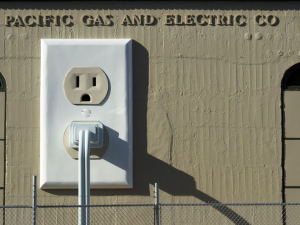
An art installation titled “Outlet-plug-cord” (2015) by Basal Ganglia Studio is displayed on the side of a Pacific Gas & Electric substation in Petaluma. (John G. Mabanglo / REX Shutterstock)
Sammy Ross – L.A. Times Pacific Gas & Electric Chief Executive Bill Johnson promised his company would emerge from bankruptcy a “reimagined utility.”
But as PG&E prepares for life after Chapter 11 — a Bankruptcy Court judge filed a written decision Wednesday saying he would approve the company’s reorganization plan — it’s unclear there’s anything fundamentally different about the utility, which over the last decade has caused a deadly pipeline explosion, deadly fires and days-long power shut-offs affecting millions of people. Read more
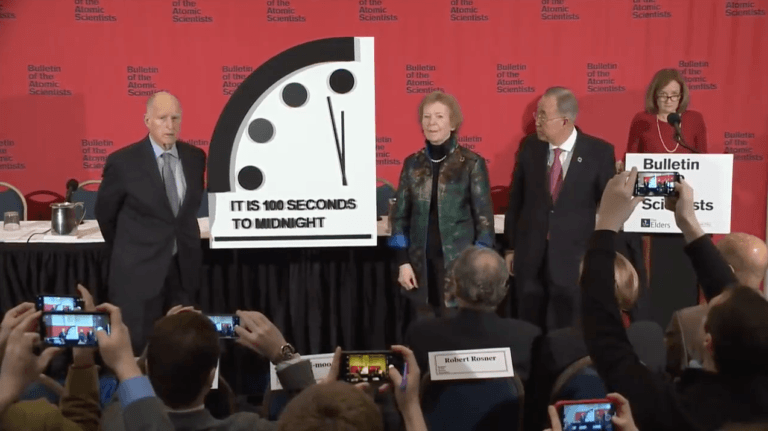
Never before this year 2020 has the world-famous Doomsday Clock registered only “100 seconds-to-midnight.” According to the Science & Security Board, Bulletin of the Atomic Scientists, since WWII, the world has never been so perilous.
Alas, it’s been a long journey (73 yrs) all the way up to 100 seconds to midnight versus the original 1947 setting of seven minutes to midnight. The safest setting was at 17 minutes to midnight in 1991 at the end of the Cold War. The wonderfully famous iconic clock is located in the lobby of the Bulletin offices at the University of Chicago.
Unceremoniously, recklessly the Trump administration carries the indisputable title as one of the most dangerous executives in the history of the country with two key issues that determine the clock’s settings: (1) climate change deniers and (2) atomic bomb explosion enthusiasts for simplicity of political gain, nothing else.
The Doomsday Clock is set by a board of scientists and professionals with depth of knowledge about nuclear technology and climate science. They are established professionals that often provide expert advice to governments and international agencies. Impressively, the Bulletins’ Board of Sponsors includes 13 Nobel Laureates. Read more…
WASHINGTON, D.C. – January 23, 2020 – The iconic Doomsday Clock symbolizing the gravest perils facing humankind is now closer to midnight than at any point since its creation in 1947. To underscore the need for action, the time on the Doomsday Clock is now being expressed in seconds, rather than minutes: Today, the Bulletin of the Atomic Scientists’ Science and Security Board in consultation with the Bulletin’s Board of Sponsors, which includes 13 Nobel Laureates, moved the Doomsday Clock from two minutes to midnight to 100 seconds to midnight.
As the statement issued today by the Bulletin of the Atomic Scientists explains: “Humanity continues to face two simultaneous existential dangers—nuclear war and climate change—that are compounded by a threat multiplier, cyber-enabled information warfare, that undercuts society’s ability to respond. The international security situation is dire…Read more
By Alan Macloed – Mint Press The latest scandal, like others before it, is based on scant testimony by anonymous officials and has had the effect of pushing liberal opinion on US foreign policy into a far more hawkish direction. Read More
“I think as Justice Jackson said in a famous decision, the Constitution is not a suicide pact,” Bolton said. “And I think defending the United States from foreign threats does require actions that in a normal business environment in the United States we would find unprofessional. I don’t make any apology for it.”
I am going to type a sequence of words that I have never typed before, and don’t expect to ever type again:
The Nuclear Regulatory Commission (NRC) is planning a very dangerous change to the way radioactive waste is handled. Some man-made nuclear waste, mainly from nuclear power, is very long-lasting and dangerous to human health and the environment. Disregarding this danger, the NRC proposes to let regular landfill operators dispose of this radioactive waste by authorizing them as “specific exempt.” This would almost certainly result in nuclear waste leaks into our water, air, crops, and communities. Tell the NRC and your members of Congress: Don’t dump radioactive waste into our landfills or any other places that are “exempt” from nuclear controls. Make comments here
Weakened Safety Regulations?
This from The NIRS Team – Diane D’Arrigo Luis Hestres Denise Jakobsberg Tim Judson:
The Nuclear Regulatory Commission’s (NRC) duty is to protect the health and safety of the American people from an inherently dangerous industry. But for decades, the NRC has been badly falling down on the job.
The NRC now wants to ax one of its most basic safety regulations: emergency plans for nuclear disasters. The NRC wants to rewrite the rules so that certain kinds of new reactors will be exempt from providing site-specific Emergency Response Plans that must be approved by the Federal Emergency Management Agency. Instead, the proposal would let plant owners determine what the size of the Emergency Planning Zone (EPZ) should be—or whether offsite emergency planning is necessary at all.
This proposal would leave the public unprotected in the case of a large release of radiation. The NRC would let newfangled reactors that are untested and unproven off the hook and allow plant owners to police themselves when it comes to safety. When disaster strikes, public officials and plant operators would have to figure out—on the fly—how to protect people, who and when to evacuate, how to notify people, how to transport and shelter them, and more.
S. David Freeman, an engineer, lawyer and Stetson-sporting “green cowboy” who championed renewable energy, advised three presidents and led some of the nation’s largest public utilities, died May 12 at a hospital in Reston, Va. He was 94. Read More
Lifetime No Nukes Record Freeman helped close down more nuclear reactors in his career than any other administrator.
In this exclusive April, 2013 EON interview, Freeman laid out – in his characteristically outspoken style – why he was then working with local activist groups and Friends of the Earth (FoE) to close down Southern California Edison’s leaking SONGS plant.
Edison announced the plant’s final shutdown just 3 months later on June 7, 2013.
Another feather in S. David’s signature Stetson.
Please check out our forthcoming feature documentary on the emblematic San Onofre story – in which Freeman appears – SHUTDOWN.
If you want to make a tax-deductible contribution to EON’s on-going work, you can do so here.


 The Nuclear Regulatory Commission (NRC) is planning a very dangerous change to the way radioactive waste is handled. Some man-made nuclear waste, mainly from nuclear power, is very long-lasting and dangerous to human health and the environment. Disregarding this danger, the NRC proposes to let regular landfill operators dispose of this radioactive waste by authorizing them as “specific exempt.” This would almost certainly result in nuclear waste leaks into our water, air, crops, and communities.