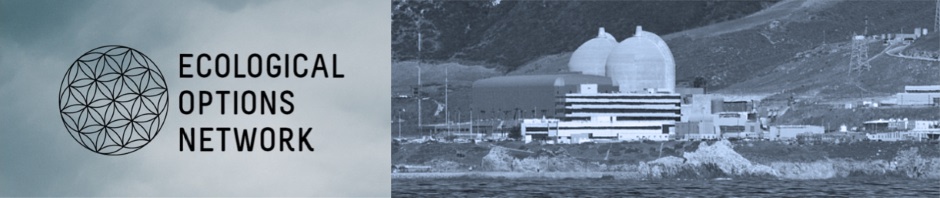

By James Heddle and Marybeth Brangan

Diablo Boys Cartoon by Mark Bryan – ArtOfMarkBryan.com
Rickety & Risky
Diablo Canyon Unit 1 is on the NRC’s short list of the worst embrittled pressurized water reactors in the U.S. along with 4 others – including New York’s Indian Point.
“Embrittlement” happens over time as the steel in the reactor pressure vessel becomes weakened by intense long-term neutron bombardment from the radioactive fuel inside. As pressurized water reactors (PWRs) age they become increasingly vulnerable to ‘pressurized thermal shock risks.’ Rapid severe cooling plus sudden re-pressurization could shatter the weakened reactor vessel like a glass and cause through-wall cracks that would allow intense radioactivity to escape.
Another Nail in Diablo’s Coffin?
In the case of Diablo Canyon – located over 13 intersecting earthquake faults in a tsunami zone on California’s coast north of Santa Barbara – this adds thermal shock risks to the seismic and fire safety risks already afflicting the aging plant.
Then there’s the sobering fact that the plant is operated by Pacific Gas & Electric (PG&E), a company under multiple federal indictments for safety violations in the recent fatal explosion of its San Bruno, CA gas pipeline, and embroiled in an evolving scandal about illegal back-channel communications with the state’s Public Utilities Commission (CPUC).
Here’s how the NRC explains embrittlement:
Reactor pressure vessels, which contain the nuclear fuel in nuclear power plants, are made of thick steel plates that are welded together. Neutrons from the fuel in the reactor irradiate the vessel as the reactor is operated. This can embrittle the steel, or make it less tough, and less capable of withstanding flaws which may be present. Embrittlement usually occurs at a vessel’s “beltline,” that section of the vessel wall closest to the reactor fuel.
Pressurized water reactors (PWRs) are more susceptible to embrittlement than are boiling water reactors (BWRs). Source
Here’s how Fairewinds’ Arnie Gundersen explains embrittlement:
Nuclear Crack Down from Fairewinds Energy Education on Vimeo.
A National Issue for America’s Fleet of Aging Nuclear Plants
The news about Diablo’s embrittlement rating comes thanks to Kevin Kamps of BeyondNuclear.org, who has been working on the campaign to shut down Entergy’s Palisades atomic reactor on the shore of Lake Michigtan, just across the lake from Chicago.
A southwest Michigan native, and board member representing the Kalamazoo Chapter of Don’t Waste MI, which filed a winning intervention with the U.S. Nuclear Regulatory Commission (NRC) Atomic Safety and Licensing Board (ASLB) regarding aging plant’s continued operation, Kamps says, “We filed this intervention in hopes of preventing a Fukushima on the Lake Michigan shoreline. The Japanese Parliament concluded that collusion between regulator, industry, and government officials was the root cause of the ongoing Fukushima nuclear catastrophe, and frighteningly, we’ve got that in spades at Palisades, between NRC, Entergy, and the likes of U.S. Representative Fred Upton.”.
He notes that the Great Lakes downstream from Palisades serve as the drinking water supply for 40 million people in eight U.S. states, two Canadian provinces, and a large number of Native American First Nations, not to mention Chicago’s drinking water supply.

A kayaker shoves off onto Lake Michigan from the beach at Van Buren State Park near the Palisades Nuclear Powerplant. Grand Rapids Press File Photo
[ See also: UCS’s Lochbaum’s insights on RPV embrittlement risks at Entergy’s Palisades atomic reactor ]
Successful Activist Intervention
According to a joint press release from Beyond Nuclear and Michigan Safe Energy Future—Shoreline Chapter on the ASLB Panel’s decision in response to their intervention,
The ASLBP also cited the coalition’s reliance on a Greenpeace Belgium expert report on potentially catastrophic micro-cracking in two Belgian RPVs as grounds for granting the evidentiary hearing. Greenpeace Belgium cited two nuclear materials experts, as well as the head of the Belgian nuclear regulatory agency, as warning that RPVs worldwide should be carefully examined for such micro-cracking, due to pressurized hydrogen blistering of the RPV metal. NRC has required no such tests, nor has Entergy performed them. The coalition urges that Palisades be the first U.S. RPV to be subjected to such an examination, given the plague of problems already known.
Critics have for decades brought to the attention of the NRC the dangerously advanced embrittlement at Palisades. Despite hard-to-garner meetings with NRC Commissioners (Magwood, in March 2013) and Chairmen (Jaczko in May 2012; Macfarlane in June 2014) having been secured on Palisades’ RPV safety concerns, each time this fragile can has been kicked further down the road by the captured, complicit, and inept regulatory agency.
Intervenor Alice Hirt with Don’t Waste Michigan in Holland said “I feel like Alice in Atomic Blunderland, hearing Humpty Dumpty tell me we can’t take the metal sample, because if we take the sample, we won’t have any samples left to take. Consequently, they operate the reactor vessel blind to the potential of shattering, fracturing, or tearing, which would render Lake Michigan and surrounding environs uninhabitable forever. This is criminal negligence.” (scroll down for full text)
Relevance to Diablo
In a post addressed to ‘Dear Diablo Canyon watchdogs,’ Kamps draws attention to the following paragraph in SUMMARY OF THE MARCH 19, 2013, PUBLIC MEETING WEBINAR REGARDING PALISADES NUCLEAR PLANT : https://pbadupws.nrc.gov/docs/ML1310/ML13108A336.pdf
On March 19, 2013, the U S. Nuclear Regulatory Commission (NRC) held a two part Public Meeting webinar to discuss NRC’s perspectives on pressurized thermal shock (PTS)….The NRC staff stated in the opening remarks that the second part of the meeting was geared towards answering follow up questions from the public about PTS….
4. Which are the other most embrittled plants in the U.S.? How many PWRs will reach their screening criteria in the next 10 years?
The NRC currently estimates that the following plants will exceed the PTS screening criteria of 10 CFR 50.61 during their 20-year period of operation beyond their original 40 year licenses. Updated fluence calculations, capacity factors changes, power uprate, new surveillance data, and improved material property information (i.e., the use of direct rather than correlative measurements of the vessel material’s resistance to fracture) can change these estimates. For example, Point Beach has made a recent licensing submittal that seeks to use improved material property information to re-evaluate the level of embrittlement in the vessel. If approved, it is estimated that Point Beach would not exceed the screening criteria of 10 CFR 50.61 during their 20-year license extension period.
1. Point Beach 2 (2017)
2. Palisades (2017)
3. Diablo Canyon 1 (2033)
4. Indian Point 3 (2025)
5. Beaver Valley 1 (2033)
Another method by which nuclear power plants that are projected to exceed the screening criteria of 10 CFR 50.61 may justify their continued safe operation is to prepare a submittal following the requirements of the alternative PTS rule, 10 CFR 50.61a. Such a submittal would employ improved screening criteria that are based on updated and more accurate PTS analyses that were performed by the staff over a 10 year period.
To use these improved screening criteria, licensees would need to provide the NRC with evidence that key assumptions regarding embrittlement and flaws that underlie the staff’s PTS analysis are satisfied by the nuclear power plant. To date, the licensees for Beaver Valley Unit 1, Palisades, and Diablo Canyon Unit 1 have expressed their intention to submit updated PTS evaluations using 10 CFR 50.61a.
According to the NRC’s technical documentation on CFR 50.61a: “If an embrittled RPV had a flaw of critical size and certain severe system transients were to occur, the flaw could very rapidly propagate through the vessel, resulting in a through-wall crack and challenging the integrity of the RPV. The severe transients of concern, known as pressurized thermal shock (PTS), are characterized by a rapid cooling of the internal RPV surface in combination with repressurization of the RPV.”
Kamps, comments, “The 2033 date for Diablo Canyon Unit 1 surpassing embrittlement safety standards screening criteria is to be taken with a grain of salt. Palisades’ End-of-Life date due to RPV embrittlement has been postponed from the early 1980s…to the mid-1990s…to various years in the first decade of this century…to 2014…to April 2017…to August 2017…and now they want a green light out to 2031! So it could well be the Diablo Canyon Unit 1 also crossed over that particular danger threshold (pressurized thermal shock risks) already, as well.”
This is one more factor in the growing list of compelling reasons for the NRC to deny PG&E’s irresponsible request, bordering on insanity, to renew Diablo’s operating license for another 20 years.
Epidemic of Embrittlement
The embrittlement issue is likely to become an increasingly persuasive incentive in the growing public push to decommission America’s aging fleet of rickety, risky reactors.
=============
‘You couldn’t make this stuff up!’
After reading the above post Kevin Kamps kindly wrote us with the following additional thoughts and valuable resources:
It dawned on me just now — D’Oh! (to quote Homer Simpson) — that an earthquake could be the triggering event for the Pressurized Thermal Shock (PTS) that fractures the brittle Diablo Canyon Unit 1 reactor pressure vessel (RPV).
But then again, any number of PTS precursors could start the dominoes falling. Anything that caused the emergency core cooling system to activate, and pump colder water onto the hot RPV metal, could be all it takes.
In fact, we’ve documented the top NRC embrittlement staffer, Mark Kirk, admitting that it might not even take the P part of PTS to cause a through-wall fracture of the RPV. The temperature change alone, even before re-pressurization of the RPV, could drive a through-wall crack through the entirety of the RPV, starting at an internal flaw (and 13,000 — yes, thirteen THOUSAND — internal flaws, or micro-cracks, have been found in a single Belgian RPV — NRC and the U.S. nuclear industry refuse to take the Belgian revelations seriously, most directly and relevantly in the current Palisades proceeding!).
By the way, some serious PTS accidents took place at Rancho Seco when it was operating:
March 20, 1978: Severe overcooling accident at Rancho Seco, CA. (See also December 26, 1985 severe overcooling accident at Rancho Seco). As reported by NIRS in August 1988, “On March 20, 1978, the B&W designed Rancho Seco nuclear power plant experienced a PTS event precipitated by a control system failure. While replacing a light bulb in the integrated control system, an operator dropped the bulb into the control panel shorting out the control room instrumentation which eventually led to an overcooling of the reactor accompanied by repressurization of the vessel. The event is believed to represent the most severe and prolonged overcooling event to date with a change in temperature of 300 degrees F. per hour. [NRC safety engineer Demetrios] Basdekas was able to convince the NRC that control system failures were an unresolved safety issue, but the Commission continued to ignore these failures in their calculations on pressurized thermal shock.”
December 26, 1985: A second severe overcooling accident at Rancho Seco, CA (see March 20, 1978 above, as well). UCS published a backgrounder on this accident, and the earlier one.
I think NRC staffers — perhaps Demetrios Basdekas, one of the original NRC staff whistleblowers who brought PTS risks to light in the early 1980s — revealed to the media that had Rancho Seco been older, and more neutron embrittled, its RPV likely would have fractured under the forces of the PTS accident.
Palisades, dangerously old and embrittled, came very close to testing Entergy’s and NRC’s false assurances, on 9/25/11. Luckily, the emergency core cooling system did NOT activate completely! (which is it’s own can of worms — an ECCS that does not operate when ordered to, even inadvertently, is a sign of a real problem!) Check out the Detroit Free Press’s coverage of that 9/25/11 accident
and note, on the bottom of page 1, that “It began with a light bulb.”!
Just as did the 1978 accident at Rancho Seco!
Two near-misses at U.S. atomic reactors that involved the changing of light bulbs, gone very badly! You couldn’t make this stuff up!
Those 1978 and those 1985 postings are part of a grand chronology, or grand compilation, I’ve assembled here:
Mostly Palisades related, but not only — also about embrittlement in general.
That chronology/compilation is far from complete, but it’s a start! I did it last late November — so much more to add since, but haven’t had time!
Thanks again for spreading the word about embrittlement risks at Diablo!
And many thanks to Kevin for providing his technical perspective and helping to preserve our collective institutional memory!
=================
Kevin also attached the following press release from the Michigan campaign:
For Immediate Release, July 9, 2015
Contact: Kevin Kamps, Beyond Nuclear, (240) 462-3216Terry Lodge, environmental coalition attorney, via email at: tjlodge50@yahoo.com
Bette Pierman, Michigan Safe Energy Future—Shoreline Chapter, (269) 369-3993Nuclear Licensing Board Denies Entergy’s Request for Delay in Disclosing Documents on Risk of Brittle Vessel Fracture at Palisades Atomic Reactor
Environmental Coalition Argued Safety Significance Demands Prompt Disclosure, Maximum TransparencyCovert, MI and Rockville, MD—At the agency’s HQ near Washington, D.C., a U.S. Nuclear Regulatory Commission (NRC) Atomic Safety and Licensing Board Panel (ASLBP) has issued a unanimous “Order Denying Entergy’s Motion to Defer Initial Disclosures.” This is the second major legal victory for an environmental coalition seeking the permanent shutdown of Entergy Nuclear’s Palisades atomic reactor on the Lake Michigan shoreline, which has the worst embrittled reactor pressure vessel (RPV) of any U.S. pressurized water reactor. Today’s Order, and all related documents, are posted online at: https://www.beyondnuclear.org/safety/
The first legal victory was the granting of an evidentiary hearing to the environmental coalition, on the merits of its technical safety concerns, issued by a 2-1 split decision of the ASLBP on June 18. The coalition is calling for closure of Palisades due to the age-related degradation of its RPV walls and welds, caused by 44 years of neutron radiation bombardment and thermal stresses.
Entergy has indicated it will appeal the ASLBP’s June 18th granting of a hearing to the environmental coalition, by its July 13th deadline for doing so, to the full NRC Commission. However, today’s ASLBP Order requires Entergy to make mandatory documentary disclosures related to these RPV safety risks by July 31st. Entergy had requested such disclosures be postponed for 90 days, or until the NRC Commission had ruled on its appeal, in hopes that a cancellation of the hearings would do away with any mandatory disclosure requirements altogether.
The U.S. Nuclear Regulatory Commission (NRC) staff, which likewise opposes the environmental coalition’s intervention, will now also be required to publish documents in a hearing file, sooner rather than later. NRC has announced that its Safety Evaluation Report on Entergy’s Equivalent Margins Analysis (EMA) will likely be published in late November, 2016. Palisades’ RPV will violate Title 10 of the Code of Federal Regulations, Part 50, Appendix G safety standards by December 2016, unless Entergy’s application for an EMA-based License Amendment Request (LAR) is approved by NRC beforehand.
“We are the only party in this case who’re looking out for the protection of the public,” said Terry Lodge of Toledo, who serves as the coalition’s legal counsel. “We believe there may be disturbingly frank exchanges between the NRC Staff and Entergy which they would prefer not become public. The fact that the Staff sided with Entergy to try to thwart the public’s access to information is the proof of how little they respect the public and a great disappointment.”
“Entergy’s reliance on ‘Equivalent Margins Analysis’ is a leap of logic that no one should fall for,” stated Michigan Keegan of Don’t Waste Michigan. “It’s time to pull the plug on Palisades, and shutdown before meltdown,” Keegan concluded.
The coalition, comprised of Beyond Nuclear (Takoma Park, MD), Don’t Waste MI (Grand Rapids), MI Safe Energy Future—Shoreline Chapter (South Haven), and Nuclear Energy Information Service (NEIS, of Chicago), on March 9th filed an intervention petition against Entergy’s second major LAR to NRC in just the previous few months, due to chronic age-related degradation of the RPV at Palisades.
This current Entergy LAR seeks to apply an EMA regarding loss of safety-significant Charpy V-Notch “Upper-Shelf Energy” in RPV plates and welds. If successful, the intervention could force the permanent shutdown of the 44-year-old, problem-plagued nuclear power plant. The coalition cites the risk of catastrophic release of hazardous radioactivity to the environment due to a potential “ductile tearing,” or fracture, of the neutron radiation-embrittled and thermally stressed RPV, causing a Loss-of-Coolant-Accident (LOCA), core meltdown, and containment failure.
Links to the ASLBP’s ruling, the coalition’s intervention petition and contention, and related documents (the coalition’s expert witness declaration, by Arnold Gundersen, Chief Engineer at Fairewinds Associates, Inc. of Burlington, Vermont; a relevant, recent Greenpeace Belgium expert report; etc.) have been posted at Beyond Nuclear’s website at this link: https://www.beyondnuclear.org/safety/
“Finally, after years of expressing concerns about the embrittled RPV and the poor welding quality history at Palisades, we are being heard that there is a problem with their testing and monitoring methods,” said Bette Pierman, Chair of Michigan Safe Energy Future—Shoreline Chapter, who resides in Benton Harbor, just over 10 miles from Palisades. “It is our lives that are and have been at risk as this aging plant is allowed to continue to operate with equipment that has a history of breakdowns with regularity. The actual condition of this reactor pressure vessel is critical information for granting their continued operation. Relying on a dubious equivalent margins analysis is not reassuring and should not be an acceptable practice to ensure our safety at this location since it does not give us accurate information about the real situation at this plant,” Pierman concluded.
“We filed this intervention in hopes of preventing a Fukushima on the Lake Michigan shoreline,” said Kevin Kamps of Beyond Nuclear, a southwest Michigan native, and board member representing the Kalamazoo Chapter of Don’t Waste MI. “The Japanese Parliament concluded that collusion between regulator, industry, and government officials was the root cause of the ongoing Fukushima nuclear catastrophe, and frighteningly, we’ve got that in spades at Palisades, between NRC, Entergy, and the likes of U.S. Representative Fred Upton.”
The Great Lakes downstream from Palisades serve as the drinking water supply for 40 million people in eight U.S. states, two Canadian provinces, and a large number of Native American First Nations. In fact, the risk to Chicago’s drinking water supply from Lake Michigan is what has motivated NEIS of Illinois to watchdog Palisades for decades.
The RPV contains the reactor core and its highly radioactive nuclear fuel. As confirmed by NRC, as well as the reactor’s various owners and operators, numerous times over the past decades, Palisades has long had the worst embrittled RPV in the U.S. The embrittlement is caused by neutron radiation bombardment impacting impurities – such as nickel and copper — in the RPV walls and welds. Entergy and its contractor, Westinghouse Nuclear, now admit that sulfur impurities in the metallic plates also make Palisades’ RPV vulnerable to ductile tearing.
The age-related degradation has been so bad, for so long, at Palisades, that the nuclear utilities, and NRC, had previously indicated “End-of-Life” (permanent closure) dates as early as 1995. However, that has been postponed till 1999, 2000, 2001, 2004, 2014, April 2017, and now August 2017, thanks to regulatory rollbacks. Palisades’ “Charpy V-Notch Upper-Shelf Energy” will also fall below the 50 ft.-lb. screening criteria by December, 2016, Entergy admits. The company has thus applied to NRC for yet another weakening of the safety rules, to allow continued operation into 2017 and beyond. Despite widespread environmental and public interest resistance, in 2007, NRC rubber-stamped a 20-year license extension at Palisades, allowing it to operate until 2031.
A severe overcooling of the RPV, as due to activation of the emergency core cooling system (ECCS), combined with sudden re-pressurization, could cause pressurized thermal shock (PTS) – a one-two punch that could fracture the RPV metal or welds at an internal flaw. The coalition recently appealed to the full NRC Commission to overturn the ASLBP’s rejection of a PTS-related contention, separate and distinct from this current EMA proceeding, but parallel and overlapping.
Arnie Gundersen, Chief Engineer at Fairewinds Associates, Inc. in Burlington, Vermont, provided an expert declaration, on behalf of the environmental coalition, and critiqued the beleaguered Palisades RPV in the previous December 1, 2014 filing. Gundersen’s declaration was re-submitted as the technical basis for intervenors’ current legal challenge, as well. The ASLBP majority cited Gundersen’s expert declaration as a basis for granting the evidentiary hearing on the merits of the coalition’s technical safety concerns.
Gundersen has challenged NRC’s and Entergy’s reliance on mere mathematical estimates and extrapolation, rather than readily available, hard physical data. The last metal sample (surveillance coupon) extracted and tested at Palisades was in 2003; the next scheduled is not until 2019. The ASLBP majority has ruled that the coalition’s call for the extraction and testing of one or more capsules is a permissible challenge deserving further consideration.
Fairewinds Energy Education has produced a short, humorous, educational video featuring Gundersen, explaining that PTS could fracture Palisades like a hot glass under cold water – and 2,200 pounds of pressure per square inch.
The ASLBP also cited the coalition’s reliance on a Greenpeace Belgium expert report on potentially catastrophic micro-cracking in two Belgian RPVs as grounds for granting the evidentiary hearing. Greenpeace Belgium cited two nuclear materials experts, as well as the head of the Belgian nuclear regulatory agency, as warning that RPVs worldwide should be carefully examined for such micro-cracking, due to pressurized hydrogen blistering of the RPV metal. NRC has required no such tests, nor has Entergy performed them. The coalition urges that Palisades be the first U.S. RPV to be subjected to such an examination, given the plague of problems already known.
Critics have for decades brought to the attention of the NRC the dangerously advanced embrittlement at Palisades. Despite hard-to-garner meetings with NRC Commissioners (Magwood, in March 2013) and Chairmen (Jaczko in May 2012; Macfarlane in June 2014) having been secured on Palisades’ RPV safety concerns, each time this fragile can has been kicked further down the road by the captured, complicit, and inept regulatory agency.
Intervenor Alice Hirt with Don’t Waste Michigan in Holland said “I feel like Alice in Atomic Blunderland, hearing Humpty Dumpty tell me we can’t take the metal sample, because if we take the sample, we won’t have any samples left to take. Consequently, they operate the reactor vessel blind to the potential of shattering, fracturing, or tearing, which would render Lake Michigan and surrounding environs uninhabitable forever. This is criminal negligence.”
—30—


